1. Prior to contact with Europeans, corn was more likely grown in the western Plains than in the eastern Plains.
a. true
b. false
2.
Shepard Krech (The Ecological Indian) would agree with the
following statement by Vine Deloria: “The Indian lived with his land.
. . . The white destroyed his land. He destroyed the planet earth.”
a. true
b. false
3. The Anasazi of Chaco Canyon are generally accepted by anthropologists to be the prehistoric ancestors of the modern ________ Indians.
a. Apache
b. Navajo
c. Pueblo
d. Iroquois
e. Cherokee
4.
Which of Hill's criteria when applied to anthropological research
specifies that if Variable A (e.g. population growth) causes Variable B
(agricultural intensification) then an increase in the size of a
population within a given area should result in a commensurate increase in
the amount of energy and resources invested in agricultural production per
acre and, conversely, a decrease in the size of a population should result
in a commensurate reduction in the investment of energy and resources per
acre.
a. Temporal Relationship
b. Consistency
c. Dose-Response Relationship
d. Plausibility
e. Specificity
5. Based on the following chart , which of the statements below is the most correct?
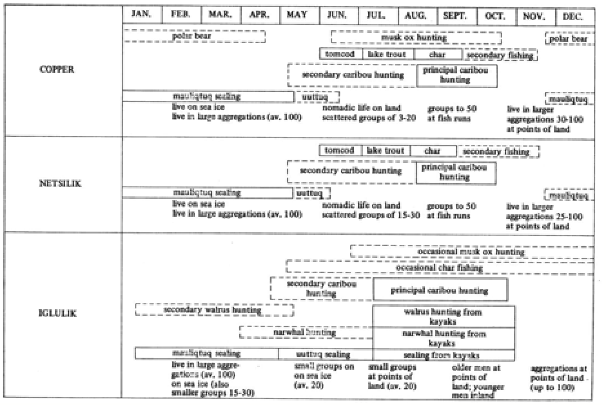
a. The Iglulik Inuit are the least dependent on marine mammals for their foo4.
b. Caribou are a primary food source for all three Inuit groups during the late summer and early fall.
c. The Copper Inuit are more dependent on sea mammals for food than are the Netsilik Eskimo.
d. All three Inuit groups form into larger than normal groups during the winter in order to hunt seal.
e.
a and d.
6. At the time of European contact, the majority of American Indian economies were
based on
a. bison hunting
b. the exploitation of wild resources
c. farming
d. fishing
e. a and b.
7. Which of the following statements is most correct?
a. Tundra ecosystems contain high productivity and high species diversity.
b. Tundra ecosystems contain high productivity but low species diversity.
c. Tundra ecosystems contain low productivity and high species diversity.
d. Tundra ecosystems contain low productivity and low species diversity.
8. Which of the following Indian groups is correctly linked with a culture area?
a. Lakota -- Northwest Coast
b. Hopi -- Great Plains
c. Iroquois -- Southeast Woodland
d. Apache -- Southwest
e. Navajo -- Great Basin
9. Which of the following statements best characterizes Vine Deloria's view of White-Indian relations as expressed in his book, Custer Died for Your Sins?
a. Those whites who are concerned with the "plight" of the Indians are the best friends of the Indian.
b. Many whites have Indian ancestors and, due to its size and its history, the Cherokee tribe is the tribe from which whites most likely have Indian ancestors.
c. Indians need whites to stop helping them and to just leave them alone.
d. Whites can help Indians by establishing task forces to study the problems of reservation life and make recommendations for ways in which life on the reservations can be improved.
e. It is in the interest of Indians to have more movies like Pocahontas and Dances with Wolves made which present a positive image of Indians that both whites and Indians can view.
10. Which of the following statements is NOT correct regarding the Inuit diet?
a. As a result of the type of resources available to the Inuit, Inuit diet consists mostly of carbohydrates.
b. Inuit diet consists mostly of protein and fat.
c. Inuit diet is considerably higher in protein even than the average American diet.
d. Inuit feed about two-thirds of the meat they catch to their dogs.
e. Inuit men have to consume nearly 3,000 calories per day in order to compensate for the high amount of calories they expend in acquiring food.
11. Which of the following is NOT a fundamental requirement of scientific research?
a. Major concepts must have empirical referents, meaning that their existence must be observable by one or more of the senses.
b. Specific phenomena under investigation (such as population size, work load or community complexity), as well as the relationships among them, must be measurable.
c. Inferences and abstractions (such as measures of behavior or social complexity) must possess intersubjectivity, i.e. they should be based on objective criteria that would lead to comparable measuring if the research were conducted by different individuals.
d. Different researchers using the same theoretical framework and the same research strategy should come to the same conclusions regarding the behavior of a particular phenomenon under investigation.
e. The relationships among the various elements included in an analysis should be both testable and refutable.
12. Which of the following groups does Andy Smith (“For All Those Who Were Indians in A Former Life”) single out in her attack on those who exploit Native American religion for personal gain?
a. New Agers in general
b. Writers who have made a name for themselves by publishing books and articles romanticizing Native American cultural practices.
c. White New Age feminists
d. White men who commercialize the use of sweat lodges and Native American “drumming” rituals.
13. Which of the following individuals would likely NOT have liked the film, “Dances with Wolves”?
a. Donald Hughes
b. Gerry Mander
c. Fergus Bordewich
d. Shepard Krech
e. c & d
14. Bordewich (Killing the White Man’s Indian) takes the opposite approach in his book as does Donald Hughes (American Indian Ecology) and Gerry Mander (“What You Don’t Know about Indians”). He argues that Indians were often wasteful of their resources, have frequently mismanaged their reservations and are today substantially responsible for their own economic problems.
a. true
b. false
15. Which of the following would be considered an energy subsidy increasing the energy flow within an ecological system?
a. rifles among the Inuit
b. rifles among the Plains Indians
c. snowmobiles among the Inuit
d. horses among the Plains Indians
e. all of the above
"The American Indians lived in the New World for twenty, thirty, forty thousand years. Everywhere they went, they learned to live with nature. They did this without destroying, without polluting, without using up the living resources of the natural world. They had learned how to live in harmony with Mother Earth, to use what she offers without hurting her."
16. Which of the following authors made the above statement?
a. Shepard Krech (The Ecological Indian)
b. Donald Hughes (American Indian Ecology)
c. Fergus Bordewich (Killing the White Man’s Indian)
d. William Abruzzi (The Myth of Chief Seattle)
17. Which of the following statements is NOT correct regarding Donald Hughes’ discussion of Native American ecology in his book, American Indian Ecology?
a. Hughes misuses the concept of “sacred” by making Native American beliefs about natural objects seem unique rather than s examples of the kind of animistic beliefs that are common among pre-industrial peoples throughout the world.
b. Hughes shows that the principles of general ecology can be used to explain specific Native American adaptive behaviors.
c. Hughes talks in generalities and provides no historical data to support his claims, even though he is a historian.
d. Hughes presents an idealistic view of Indians as living in “balance with nature” rather than a detailed analysis of the specific ecological relationships of individual Native American populations.
18. Which of the following statements is most correct regarding the practice of female infanticide among the Inuit?
a. It is usually the males, rather than the females, who prefer to kill female infants.
b. While females may agree to kill infants, the death of older children is largely caused by males, because mothers who have raised daughters are likely to have developed emotional bonds with them and are, therefore, less likely to kill them.
c. Among the Inuit, female infants are likely to be killed because, owing to the high mortality of males and the fact that almost all food production is done by men, a family would likely find itself with adult daughters that: (1) cannot be married off, (2) do not increase the wealth or prosperity of the family and (3) must be supported on the family’s limited resources.
d. Female infanticide is more likely to occur among the Inuit when the cost/benefit ratio of raising girls is lower than that for boys.
19. Which of the following statements is most correct with regard to the application of ecological theory to community development among 19th century Mormon settlements in the Little Colorado River Basin?
a. In ecological terms, the lower valley settlements were situated in highly stable habitats which possessed high productivity, and which imposed only low community maintenance costs. This resulted in high aggregate and net community productivities for these towns.
b. From the perspective of general ecology, large valleys, good soils and abundant, superior quality surface water translated into high environmental productivity for intermediate settlements. At the same time, reliable growing seasons, together with stable surface water sources, provided high environmental stability with regard to critical agricultural resources. High environmental productivity and stability combined to produce the highest and least variable community productivities of any settlements in the region. Furthermore, because intermediate settlements did not suffer the frequency of dam failures experienced in the lower valley; and because they contained the largest populations with which to undertake dam reconstruction, they also sustained the lowest per capita maintenance costs in the region. They, therefore, generated the highest net productivities and were able to support the largest and most stable populations in the basin.
c. In terms of community development, the southern highlands settlements were among the most developed Mormon towns in the region. Stated in ecological terms: high environmental productivity and stability resulted in a high net community productivity among southern highland settlements. As predicted by ecological theory, these settlements were among the most functionally diverse Mormon towns in the basin.
d. all of the above.
20. Bordewich's (Killing the White Man's Indian) discussion of the Lumbee case illustrates which of the following statements?
a. The rules for defining whether one is an Indian or not are consistent from one Indian group to the next.
b. The various Indian groups cooperate and help each other out when groups of Indians apply for recognition as a tribe by the federal government.
c. Various Indian groups have approached the Indian identity issue differently and have opposed specific people's application for Indian status when such applications threatened their own interests.
d. Despite the diversity of peoples who comprise Native Americans, the U.S. Government has established a single legal definition of “Indian” to which all Indians must qualify in order to be accepted as a tribe in the eyes of the federal government and receive government funding.
21. Which of the following statements is correct regarding the role of maintenance costs in the evolution of complex ecological communities?
a. Increased maintenance costs increase the amount of net productivity available at each trophic level in an ecological community.
b. An increase in maintenance costs increases the total amount of energy flowing through an ecological community.
c. The higher the maintenance costs, the fewer the number of distinct niches that can be maintained within an ecological community.
d. Increased maintenance costs act as an energy subsidy to the evolution of an ecological community.
22. According to Nelson, the most productive form of hunting among the Northern Alaskan Inuit in terms of both the amount of meat received and the preferred food to eat is
a. Caribou hunting
b. Breathing hole seal hunting
c. Ice edge sealing
d.
Whaling
* * * * *
Briefly Discuss the Following
(two-page essays)
Black Elk Speaks Chief Seattle Cultural and Natural Areas
"Europeans did not find a wilderness here; rather, however involuntary, they made one."
“Bitches simply don't pull as hard as male dogs do.”
The Ecological Indian The White Man's Indian