U.S. Elections
The Myth of Democracy
Americans are repeatedly told how important it is to vote and how much every
vote counts. Voting is promoted as the basis of a free and democratic society,
However, the overwhelming majority of election data does not support the belief
that individual voting makes a difference.
In fact,
due largely to
Gerrymandering
and disproportionate
campaign spending,
most elections in the U.S. are determined long before voters go to the polls,
with incumbents all-but-guaranteed reelection.
*
* * * *
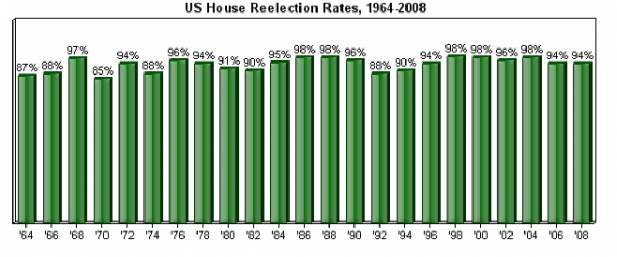
The average reelection rate for incumbents for at least the last 50 years has been about 95%.
Even in 1994, the year of the so-called "Gingrich Revolution" in which Republicans gained 54 seats in the House of Representatives, fully 90% of House incumbents were reelected.
In 2000, the Center for Responsive Politics made a list of 237 seats it thought would be won by landside margins (i.e., over 20%).
-- 98% of House incumbents won reelection that year.
-- Only 1 of the 237 seats was won by less than 20%.
-- That seat was won by an 18% margin.
In 2002, the reelection rate was 88% in the Senate and 96% in the House.
According to Ballotpedia, in 2020, only 89 congressional seats (12 Senate and 77 House) were decided by less than 10%. That same year, in only 42 races was the margin of victory less than 5%. In others words, the overwhelming majority of Congressional races were not even close to being competitive.
The same can be said for Congressional elections in other years:
--In 2018, in only 102 races was the margin of victory less than 10%, and in only 50 races was it less than 5%.
--In 2016 only 42 races were decided by a margin of less than 10% and just 22 by a margin of less than 5%.
--In 2014, only 56 elections were won by a margin of less than 10%, while a mere 31 races were decided by a margin of less than 5%.
In the 2004 election for the House of Representatives,
-- Over 85% of House incumbents won by landslides of more than 60%.
-- Only 7 incumbents of 399 running (2%) were not reelected.
-- Outside of Texas (where redistricting led to the defeat of four targeted Democrats) only 3 incumbents were not reelected.
-- In the remaining 49 states, the reelection rate exceeded 99%.
In 2010, the incumbent reelection rate was 87% for the House and 84% for the Senate.
In 2012, the incumbent reelection rate increased to 90% for the House and 91% for the Senate
And in 2014, according to Politifact, despite the fact that Congress only had an 11% approval ratings, 96.4 % of incumbent lawmakers were re-elected in 2014.
And again in the 2016 elections, despite the election of Donald Trump who ran against the Congressional establishment, 97% of incumbents in the House and 94% of incumbents in the Senate were re-elected.
The power of incumbency continued even into the highly charged 2020 elections. According to Ballotpedia, 94% of incumbents nationwide, including all levels of government, won re-election. The re-election rate in Congress was 96% , while 95% of State-level incumbents won won re-election.
House elections have become significantly less competitive over time:
-- In the 1950s: between 20-25% of contested House seats were decided by margins of 10 points or less.
-- 2000 - 2002: less than 3% of house seats were decided by a margin of less than 10%.
-- Reelection rates to state legislatures are, on average, even higher than that for the U.S. Congress.
-- In the final analysis, the reelection rate in the U.S. is not significantly different from the reappointment rate to such unelected legislative chambers as the National People's Congress in China and the Politburo in the former Soviet Union.
Why are reelection rates so
high in the U.S.?
While several factors may be listed, two stand out:
1. Candidates who spend the most money win between 80-98% of elections in the U.S.
|
SOURCE: www.opensecrets.com/news/2012/01/big-spender-always-wins |
Incumbency has its privileges:
In 2018, over 90% of incumbents in the House of Representatives and just under 89% of incumbents in the Senate won re-election.
Meanwhile, in the 2020 election, 93% of incumbents nationwide (in both state and federal elections) were reelected. The highest incumbent reelection rate was in New Jersey (100%) and the lowest was in California (85%). The average incumbent reelection rate in Congressional races that year was 96%, with 37 states achieving a 100% Congressional incumbent reelection rate.
-- Incumbents outspend challengers by an average of 3-to-1.
-- On average, House incumbents outspent challengers by nearly $565,000.
-- Senate incumbents outspent their challengers by an average of $3.13 million.
-- In 2/3 of all House races in 2000, incumbents out-raised challengers by more than 10-to-1.
-- Presidential candidates spent $1.7 billion in the 2008 U.S. election campaign, more than double the amount in 2004.
-- President-elect Barack Obama spent $740.6 million in his 2008 presidential election campaign.
-- That was larger than the combined $646.7 million that Republican President George W. Bush and Democratic nominee John Kerry spent in 2004.
-- By comparison, Canada spent roughly $300 million for their entire 2008 election.
-- Combining the money spent by both the Obama Campaign Committee and the Democratic Party on his reelection, President Obama's 2012 re-election cost $1.1 billion.
-- That expenditure is about 20 times the entire amount spent by all candidates in Parliamentary elections in Great Britain. (whose elections are limited to 6 weeks).
-- Obama's spending alone is comparable to the amount needed to finance UK elections for the entire 21st century.
--The Romney campaign and the Republican Party together spent nearly $1 billion dollars on his failed election.
-- Since all the Republican presidential candidates combined spent about as much as Obama spent, the amount of money spent on the 2012 presidential campaign would be sufficient to finance British elections for the next two centuries.
--When you include the cost of congressional elections, the total expenditure on U.S. elections in 2012 was $7 billion.
--That would cover the cost of British elections for several centuries to come!
2. Election districts have been drawn up by politicians to assure their reelection.
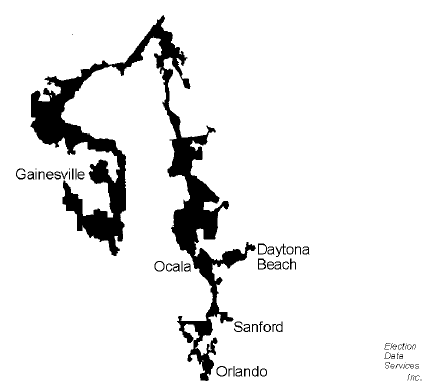
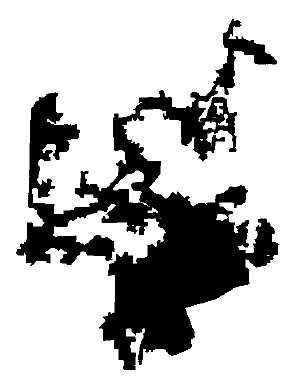
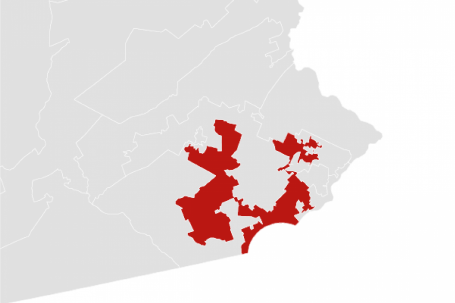
Gerrymandering
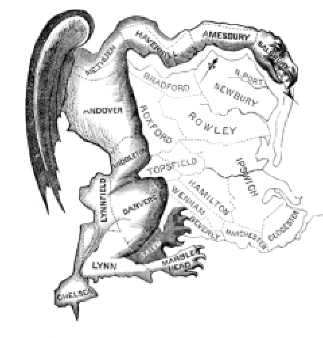
Gerrymandering
refers to the practice of manipulating electoral district boundaries in order to enhance the political advantage of a particular party or group. It has been used over the years by both Democrats and Republicans, as well as by white majorities to maintain political advantage over racial and ethnic minorities. The practice obtained its name from a drawing in the March 26, 1812 edition of the Boston Gazette in response to Massachusetts Governor Eldridge Gerry's signing of a bill to redistrict electoral districts to the benefit of his Democratic-Republican Party. In the new electoral districts map, one of the contorted districts resembled a salamander, which resulted in it being called a Gerry-mander.
Some Gerrymandered Districts Today
|
Florida 4th Congressional District
|
Texas 30th Congressional District
|
|
Illinois 4th Congressional District
|
Pennsylvania 7th Congressional District |

Maryland 3rd Congressional District
("The Praying Mantis")
For a look at the 10 Most Gerrymandered Congressional Districts (in 2010), click on the following link:
Washington Post: Ten Most Gerrymandered Congressional Districts in the U.S.
The Results . . .
--Fewer than 1 in 10 House races are decided by a margin of less than 10%, meaning less than 10% of voters have a real voice.
-- “In 90% of the country, today's congressional races were essentially decided long ago. State legislatures, eager to make seats safe for their parties, have gerrymandered district boundaries so that fewer than 40 of the nation's 435 House seats are really competitive. .” -USA Today 11/7/00
-- In other words, politicians choose the voters long before the voters choose them.
--The Pennsylvania Legislature is currently considering proportional voting in which the Electoral College vote will be divided up by congressional districts rather than being awarded by the state as a whole. This will increase the pressure on the state's dominant party (Republicans) to gerrymander districts in order to maximize its vote in presidential elections. Other states are considering similar legislation.
-- In 64 Congressional districts (14.7%), the population is so lopsidedly Democratic or Republican that only one major party's name even appears on the ballot.
-- Another 300+ seats are so configured that even when there is competition, the result is usually a landside (over 20%).
-- For all intents and purposes, over 90% of elections to the House of Representatives are over before they even begin.
--Gerrymandering has also affected elections at the state level. According to Politico, in 2020, there were 37 states experiencing one-party rule. In that year, Republicans controlled 23 states, while Democrats controlled 13. Furthermore, the number of states with one-party rule has steadily increased in recent years. While 17 states had divided governments in 2018, that number dropped to 13 in 2020 and has currently decreased to only 12, according to the National Conference of State Legislatures.
* *
* * *
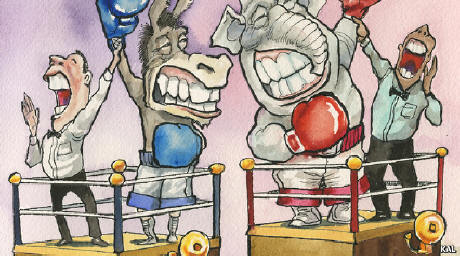
(The Economist, October 25, 2014)
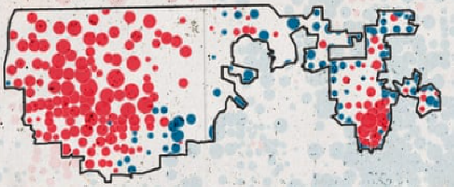
These Maps Show How Republicans Are Blatantly Rigging Elections
(The Guardian, November 12, 2021)
*
* *
And this is what American elections produce:

The Many Scandals of Donald Trump: A Cheat Sheet
(The Atlantic, January 1, 2017)
* * * * *

* *
* * *