1.
Which of the following Yanomamo villages is best able to adhere to the
ideal marriage rule (marrying a cross cousin)?
1.
large
villages engaged in warfare
2. large
villages not engaged in warfare
3.
small
villages engaged in warfare
4. small
villages not engaged in warfare
2. A model of population, such as that proposed by Thomas Malthus, in which population growth is seen as the natural result of an “urge to reproduce” would be considered “Aristotelian” because the factors determining population growth derive exclusively from the “natural” (i.e., non-measurable) characteristics of the population rather than from the interaction of quantitatively definable and measurable characteristics of both the population and the external circumstances to which the population must adapt.
1. True
2. False
3.
Which of the following facts is both true
AND
is evidence for the importance of population pressure and resource
competition in Yanomamo warfare?
1.
The male / female sex ratio is lower in the central villages than it
is in the peripheral villages.
2.
The frequency of raids between villages is higher among the
peripheral villages.
3.
The central Yanomamo villages are larger and closer together than
the peripheral villages.
4.
The central villages are less dependent on food cultivation than
the peripheral villages.
5.
The peripheral villages are more dependent on cultivation than are
the central villages because they must provide food for feasts in order to
cement alliances.
4. Which of the following statements best describes Napoleon Chagnon's response to Marvin Harris' thesis that warfare among the Yanomamo results from competition created by protein scarcity?
1. Protein consumption among the Yanomamo may be marginal, but it is not low enough to cause warfare.
2. The Yanomamo have adapted physiologically to low protein supplies and, therefore, do not require as much protein intake as members of industrial societies.
3. The Yanomamo are well nourished and, thus, not suffering from the kind of protein deficiency that would lead to competition and warfare.
4. Harris is correct in arguing that protein supply is an important factor in
Yanomamo warfare, but not for the reasons he thinks. The Yanomamo are
involved in warfare not because of protein scarcity, but because they have
a protein surplus that gives them an advantage over neighboring groups
with less nutritious diets.
5. One problem with a "cultural" explanation of Yanomamo warfare is that
1. it cannot explain both the high level of warfare among the central villages and the low level of warfare among the peripheral villages.
2. it cannot account for the variable intensity of warfare within the same village through time.
3. it constitutes an Aristotelian explanation
4. a constant cannot explain a variable.
5. all of the above.
6. Which of the following anthropologists views Yanomamo warfare as a positive-feedback system?
1. Chagnon
2. Harris
3. Abruzzi
4. Abruzzi and Harris
5. Harris and Chagnon
7. The system of exchange practiced by a group of people is classified within
1. superstructure
2. infrastructure
3. structure
8. Chagnon's data indicate that per capita daily protein intake among the Yanomamo is ____________ that of most other Amazonian Indians.
1. much higher than
2. comparable to
3. less than
9. Which of the following is NOT a basic rule of anthropological research?
1. non-interference with the customs of the people being studie4.
2. preserving the anonymity of the informants.
3. protecting the confidentiality of the information collecte4.
4. providing whatever support the people might request.
10. Yanomamo villages are least likely to be raided (and thus are safest) during
1. the rainy season
2. the dry season
3. when it snows
11. Which of the following research techniques most clearly distinguishes anthropological research from research in the other social sciences?
1. questionnaires
2. surveys
3. using cameras to record information
4. participant observation
12. You give someone a $30 present for his/her birthday in the hopes that when your birthday comes around he/she will get you that $100 Sony Discman you want. From an anthropological perspective, you are practicing
1. balanced reciprocity
2. negative reciprocity
3. generalized reciprocity
4. Yuppie sentimentality
13.
If members of one village in India are expected to marry someone from
another village, which of the following marriage rules is operating?
1. endogamy
2. exogamy
3. the levirate
4. the sororate
5. polyandry
14. Anthropological research has demonstrated that women are genetically inclined to be less aggressive and more nurturing than men.
1. true
2. false
15. The Book of Genesis was part of the ______________ of the ancient Israelites.
1. etic view
2. bilateral descent system
3. superstructure
4. infrastructure
16. From an anthropological perspective,
1. Genesis, like any other genealogy, must be accepted as an accurate account of historical kinship relationships.
2. The genealogy in Genesis must be treated differently from the genealogy of other peoples, such as the Yanomamo and the Ju/'hoansi.
3. Genesis must be considered part of the emic worldview of the ancient Israelites rather than an accurate account of the origin and early history of humankind.
4. Abraham must have been a real person, because too much information exists in the Old Testament about his existence and travels throughout the ancient Near East.
17. Which of the following evidence, according to Marvin Harris, suggests that the Yanomamo may be experiencing protein scarcity?
1. The Yanomamo frequently go on 5-day unsuccessful hunting expeditions
2. Yanomamo reliance on insects for food.
3. There are relatively few meat sources available in the rain forest compared with open grasslands.
4.
all of the above.
18. According to the following definition of Patriarchal Society presented by Radcliffe-Brown, the United States would be defined as a patriarchal society.
“A society may be called patriarchal when descent is patrilineal,
marriage is patrilocal, inheritance of property and succession to rank are
in the male line, and authority over members of the family are in the
hands of the father and his relatives.”
a. true
b. false
19. Which of the following statements is NOT correct, according to Abruzzi, (“Genealogy, Politics, History in the Book of Genesis”)?
1. Biblical scholars have defined four distinct "documents" in the first five books of the Hebrew Bible: the E-Document, J-Document, P-Document and Deuteronomy. These four documents frequently present separate versions of the same story and represent different, often conflicting, political divisions among the ancient Israelites.
2. The Bible contains at least two different versions of the Flood Story, one in which it rains 40 days and 40 nights and 7 pairs of animals are gathered onto the ark, the other in which it rains for 150 days and only 2 of every type of animal are herded onto the ark.
3. Many words and phrases appear in the Bible that cannot be translated literally into English. Such words and phrases must be understood in the context of the language of the Bible at the time those words and phrases were written. When it states in the Hebrew Bible that someone was “naked” in the presence of another person, it means that the individual in question performed inappropriate sexual behavior with that person.
4. The Bible states that both of the Lot's daughters had a child as a result of having sexual intercourse with their father. The older daughter gave birth to a son named Moab (the eponymous ancestor of the Moabites), and the younger daughter bore a son named Ben-ammi (the eponymous ancestor of the Ammonites). The Moabites and Ammonites were two competing kingdoms to the east of Israel. This story rationalized the subordinate political relation of the Moabites and Ammonites to the Kingdom of Israel under David and Solomon.
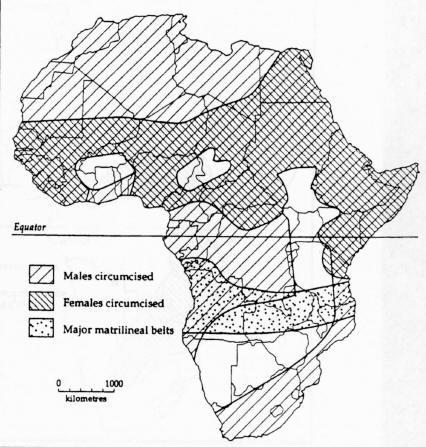
20. Which of the following statements is NOT illustrated by the map above?
1. Male circumcision is more widely practiced in Africa than female circumcision.
2. Female circumcision is not practiced among the matrilineal societies of Africa.
3. Female circumcision is not practiced where male circumcision is also not practiced.
4. Male circumcision is not practiced among any of the matrilineal societies.
5. Male circumcision is practiced throughout the majority of the African continent, whereas female circumcision is not.