Disregard the questions that are BLUE at the end of the page
This material will not be on the first test.
It will be included on the second test instead.
1. The Statement that "Science is Sciencing" means that
1. Science is not defined as an “organized body of knowledge”, such as chemistry, physics, astronomy and biology, but rather as a particular method by which we investigate and explain the world around us, regardless of the academic discipline in which it takes place.
2. Science is more appropriately viewed as a verb than as a noun.
3. The periodic table and the Linnean classification system are the results of doing science, not an example of science.
4. Science is a process, not a product.
5. all of the above.
2. Which of the following statements is most correct? So far, this course has
1. emphasized the importance of explaining the variety of social behavior of different peoples in terms of distinct local values and belief systems.
2. stressed the concept of "culture" as the most important factor explaining social behavior.
3. focused on the consequences of a specific population's relationship to the resources it needs to maintain itself for determining that population's social organization and belief system.
4. has stressed the importance of an empirically-based scientific approach to the study of human social behavior.
5. 3 and 4.
3. Which of the following would be included by Harris and Johnson in infrastructure?
1. Christian belief in the virgin birth of Jesus
2. coal mining in West Virginia
3. the distribution of shopping malls in Bucks County
4. traffic jams on the Los Angeles Freeway
5. the story of Noah's ark
4. Which of the following statements best describes Napoleon Chagnon's response to Marvin Harris' thesis that warfare among the Yanomamo results from competition created by protein scarcity?
1. Protein consumption among the Yanomamo may be marginal, but it is not low enough to cause warfare.
2. The Yanomamo have adapted physiologically to low protein supplies and, therefore, do not require as much protein intake as members of industrial societies.
3. The Yanomamo are well nourished and, thus, not suffering from the kind of protein deficiency that would lead to competition and warfare.
4. Harris is correct in arguing that protein supply is an important factor in Yanomamo warfare, but not for the reasons he thinks. The Yanomamo are involved in warfare not because of protein scarcity, but because they have a protein surplus that gives them an advantage over neighboring groups with less nutritious diets.
5. A model of population, such as that proposed by Thomas Malthus, in which population growth is seen as the natural result of an "urge to reproduce" would be considered "Aristotelian" because the factors determining population growth derive exclusively from the "natural" (i.e., non-measurable) characteristics of the population rather than from the interaction of quantitatively definable and measurable characteristics of both the population and the external circumstances to which the population must adapt.
1. true
2. false
6. Frank Furedi ("North Waging Cultural War against South.") criticizes Westerners for
1. assuming that they have the right and moral superiority to undermine the cultural practices of indigenous peoples which Westerners find offensive.
2. attempting to impose Western views regarding population growth onto indigenous peoples in Third World countries for whom those views are not necessarily appropriate.
3. expecting peoples in non-Western countries to adopt behaviors and lifestyles that may be at variance with prevailing norms in those countries.
4. all of the above.
5. none of the above.
7. Which of the following statements is the least correct regarding tourism?
1. Tourism is often mistakenly seen as an unqualified benefit to developing communities that brings money into a community without creating pollution and other social costs.
2. Tourism results in a kind of colonialism, according to Rothman (Devil’s Bargains) because it results in a local community becoming defined and economically dominated not by the people who live there but by outsiders and by outsiders’ notions of what the town should be like.
3. Tourism infrequently results in actual cross-cultural communication because both the tourist and the people performing for the tourists rarely interact with one another outside of the stereotyped roles established by the tourist setting.
4. In most cases, as illustrated by the Maasai of Kenya, local peoples want to give tourists an authentic cross-cultural experience in recognition of the economic benefits that the tourists bring to their community.
8. Which of the following is true about the Yir Yuront ("Steel Axes for Stone-Age Australians")?
1. Those villages which got the steel axes first attacked the villages that had only stone axes and wiped them out.
2. Because of the critical role that the stone ax played in reinforcing the social organization of the Yir Yoront, its replacement led to the disintegration of Yir Yuront society, even though no one was actually killed as a result of the introduction of the steel ax.
3. The missionaries purposely tried to cause the disintegration of Yir Yuront society in order to better convert them to Christianity.
4. The innocent introduction of the steel ax by the missionaries led to a revolution among the Yir Yuront as the younger men and the women banded together to drive the older men from power.
9. Which of the following types of explanation would be classified as Galileian (as opposed to Aristotelian)?
1. Explaining human warfare in terms of innate male aggressiveness.
2. Racial explanations for high crime rates in urban areas.
3. Explaining cross-cultural differences in gender relations in terms of the different economic role that men and women play in local economies.
4. Explanations based on ethnic stereotypes.
5. Explaining environmental problems in developing countries in terms of the difference between “Western” vs. “Eastern” culture.
10. Which of the following statements is most correct (see "Taliban War on Women"?
1. As part of their attempt to enforce male dominance, the Taliban physically mutilated women who refused to act subservient to men.
2. More women than men were killed and mutilated by the Taliban.
3. The Taliban punished both men and women for not adhering to their policies, most notably those based on their strict interpretation of Islam.
4. The plight of women in Afghanistan was given more publicity in the West because, as with any special interest group, feminist organizations chose to focus primarily on the facts and the issues that fit their particular concerns.
5. 3 & 4.
11. Which of the following statements is most correct?
1. Insects are a poor food source because they provide few nutrients that are of value to humans.
2. Insects are a valuable food resource precisely because they are high in carbohydrates.
3. From an ecological point of view, the fact that the Yanomamo eat insects suggests that there are few alternative sources of protein available which require less labor to exploit.
4. Anthropologists consider insects a superior food resource to game animals because the Cost/Benefit of labor associated with harvesting insects is generally less than that for hunting game animals.
12. Chagnon's data indicate that per capita daily protein intake among the Yanomamo is ____________ that of most other Amazonian Indians. (See "The Great Protein Debate" in Chagnon, Chapter 2)
1. much higher than
2. comparable to
3. less than
13. If an anthropologist were attempting to explain a people's adaptation to their environment (e.g., Inuit adaptation to their arctic environment or Ju/'hoansi adaptation to their desert environment) in terms of how the people themselves view their subsistence behavior, he or she would be adopting an _________ perspective.
1. emic
2. etic
14.
Collecting accurate information on kinship and genealogy proved to be
much easier for Chagnon than he had anticipated.
1. true
2. false
15.
An ecological explanation,
which shows that social behaviors such as warfare, circumcision or
infanticide can be more parsimoniously explained by one set of general
principles rather than by the distinct cultural attributes unique to
each group, demonstrates which of the following concepts?
1. an emic explanation
2. an Aristotelian explanation
3. Occam's Razor
4. an
essentialist explanation
16. Which of the following statements best describes the goal of scientific research in the social sciences?
1. Research should be undertaken that supports established social norms and rules.
2. Social scientists should reject the conclusions of research that would not be socially acceptable.
3. Social science research, like research in other scientific fields, should be guided by a search for better understanding the world and not to support or confirm a specific political, religious or ideological perspective.
4. Social
scientists should not publish research that would contradict a
community's religious beliefs.
17. According to Hughes ("The Sacred Rac"), the Asu use most of the excrement of the Rac for both fuel and fertilizer, which explains why they don't kill the animals and eat them.
1. true
2. false
18.
The application of the Uniformitarian Principle requires that
anthropologists analyze the story of how the world is created in
Genesis (the first book of the Bible) the same way that they would
analyze the creation myths of other peoples, such as the Yanomamo, the
Inuit or the Pygmies.
1. true
2. false
19. Which of the following sources provided an accurate and non-ethnocentric description of the behavior of a specific group of people by accurately describing that behavior within the larger social and cultural context within which it occurred?
1. Mondo Cane
2. "The Sacred Rac"
3. "Body Ritual among the Nacirema"
4. all of the above
5. none of
the above
20. Which of Hill's criteria when applied to anthropological research specifies that if Variable A (e.g. population growth) causes Variable B (agricultural intensification) then an increase in the size of a population within a given area should result in a commensurate increase in the amount of energy and resources invested in agricultural production per acre and, conversely, a decrease in the size of a population should result in a commensurate reduction in the investment of energy and resources per acre.
1. Temporal Relationship
2. Consistency
3. Dose-Response Relationship
4.
Plausibility
21. _______ refers to the tendency to view the traits, ideas and values of your own society as superior to those of other societies.
1. cultural relativism
2. enculturation
3. anthropocentrism
4. ethnocentrism
5. egocentrism
22. Lawrence Kuznar has stated that "a concern with knowing the world, rather than advocating a view of the world because it confirms some political, ideological, or religious project, has always been fundamental to scientific philosophy." Which of the following examples best fits Kuznar's definition?
1. The Reverend Lundmark's piece on "Evolution -- Sheer Nonsense" from the Morning Call in which he uses quotes by the Presidents of Harvard and Lehigh Universities to attack the concept of evolution.
2. A faculty member who believes that a teacher should not give students all of the facts on a particular topic because it might keep them from being politically active.
3. A sociology course on domestic violence that concentrates on “battered women”, that only discusses male-on-female violence, and that ignores data relating to female-on-male violence as well as violence in gay and lesbian relationships.
4. A researcher who, having collected careful quantitative data on female labor and on the amount of food acquired by women in several hunting and gathering populations, suggests that anthropology must revamp its notions about gender relations in hunter-gatherer societies due to the fact that on average between 60-80% of the food consumed by most foraging societies is produced by women.
5.
An environmental studies course on population that focuses exclusively
on Malthusian models of population growth, which predict dire
consequences of continued population growth, and ignores non-Malthusian
models, which don't predict negative results.
23. Harris and Johnson argue that as human populations have grown over time and societies have developed new methods of food production (foraging - horticulture - agriculture - industry) to feed the larger populations, output per unit of labor input has increased, but output per unit of total energy input has decreased.
1. true
2.
false
* * * * *
1. Life is more difficult for the Kade Ju/'hoansi than for the Dobe Ju/'hoansi because
1. the Kade Ju/'hoansi live in an area with no permanent waterholes.
2. the Kade Ju/'hoansi do not have access to a single highly productive food resource such as mongongo nuts.
3. the Kade Ju/'hoansi have to dig for roots and gather melons in order to get their water, which adds to their daily work load.
4. there is less meat available to the Kade Ju/'hoansi because of the effect that the lack of permanent waterholes has on game animals.
5. all of the above.
2. Which of the following statements best summarizes the data in the tables below?
|
|
|
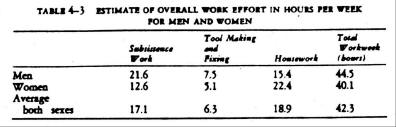
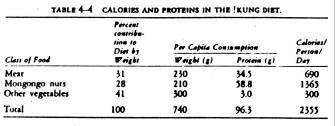
1. While the Ju/'hoansi do not spend much time in pursuit of food, they also do not maintain a nutritionally adequate diet.
2. The Ju/'hoansi maintain a nutritionally adequate diet, but they have to spend most of their time in search of food in order to maintain that diet.
3. The Ju/'hoansi achieve a nutritionally adequate diet on less than half the time the average American spends working.
4. The Ju/'hoansi work very hard and are still unable to maintain an adequate diet.
3. According to Richard Lee, the single most important food source of the Dobe Ju/'hoansi is
1. giraffe
2. tsama melons
3. mongongo nuts
4. buffalo
4. Which of the following statements is most correct? In terms of the amount of energy expended relative to the amount of energy received in the form of food,
1. Americans are at least twice as efficient as Indian peasants in their use of cattle.
2. American agriculture is both more productive and more efficient than either hunting and gathering among the Dobe Ju/'hoansi or horticulture among the Yanomamo.
3. American agriculture has become increasingly energy efficient with the greater use of pesticides, herbicides and chemical fertilizers in the last 40 years.
4. American agriculture is more productive than horticulture among the Yanomamo, but not as energy efficient.

5. According to the above chart, the Dobe Ju/'hoansi
1. congregate into larger bands primarily during the months of January and February.
2. have to travel the greatest distances for food and water during the months of June and July.
3. likely experience the most difficult subsistence during the months of March and April.
4. all of the above.
5. none of the above.