Dr. William S. Abruzzi
Department of Sociology and Anthropology
Muhlenberg College
Teaching:
I have been teaching at the college or university level for over 30 years, and I am still excited to enter the classroom and participate in a dialogue with my students. I delight in the discovery process, and I enjoy being a part of that process for others. I take great pleasure in exposing students to new ideas and new ways of thinking about subjects, and I welcome the opportunity to prod and challenge students to think more rigorously and more critically about social issues. I enjoy teaching anthropology because anthropology encompasses so many aspects of our species' existence, including our relation to other primates, our evolution from primate ancestors, the origin of agriculture, the evolution of ancient civilizations and the incredible diversity of peoples and societies which exist throughout the world today. The diverse subject matter of anthropology provides a unique opportunity to expand my students' horizons, to challenge parochial and ethnocentric theories about human behavior, and to induce students to think critically about a whole variety of social issues. I take an unabashed scientific approach, showing students that even the most exotic human behaviors can be better understood when examined rationally and with a concern for accurate data collection.
Previous Teaching Positions:
Fort Hays Kansas State College, Hays, Kansas
State University of New York at Binghamton
Ahmadu Bello University, Zaria, Nigeria
Davis and Elkins College, Elkins, WV
Penn State University, Abington Campus, Abington, PA
New Mexico State University, Las Cruces, NM
Research Interests:
My research interests are in human ecology, arid lands studies, ethnic relations, social science theory and methodology, and the anthropology of religion. Most of my research has been in the American Southwest, but I have also conducted research in Africa and Sardinia. My research focuses largely on the application of ecological and evolutionary theory to explain human social behavior and the evolution of human societies.
I have examined the effect of population pressure on the Mbuti Pygmies of the Ituri Forest in the Republic of the Congo (formerly Zaire). I have also published several articles and a book in which I apply ecological theory to explain historical developments associated with Mormon colonization of the Little Colorado River Basin in Arizona. In addition, I have examined the social and ecological consequences of overgrazing and the overexploitation of groundwater resources in the Little Colorado River Basin during the past 100 years. My most recent research focuses on issues related to population growth, on historical ethnic relations in New Mexico and on Native American ecology. I am currently working on a book titled Competition and Exclusion that applies general ecological theory to explain historical ethnic relations in New Mexico.
Publications
|
Books
1. DAM THAT RIVER! Ecology and Mormon Settlement in the Little Colorado River Basin. University Press of America. Lanham, MD. 1993.
Journal Editor
1. FORUM: of the Association for Arid Lands Studies,
Volume. 20. (2004)
Articles in Refereed Journals
1. Population Pressure and Subsistence Strategies among the Mbuti Pygmies. Human Ecology 7:183-189. (1979)
2. Ecological Theory and Ethnic Differentiation among Human Populations. Current Anthropology 23:13-31. (1982)
|
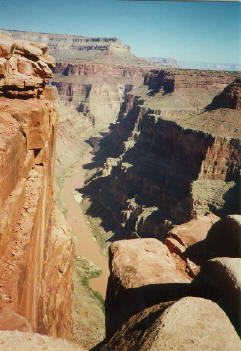
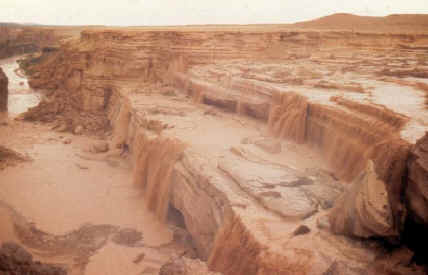
Grand Falls of the Little Colorado River |
3. Reply to F. Morin and H. Nevadomsky, 'On Ecological Theory and Ethnic Differentiation.' Current Anthropology 23:347. (1982)
4. Water and Community Development in the Little Colorado River Basin, Human Ecology 12(2):241-269. (1985)
5. Ecological Stability and Community Diversity during Mormon Colonization of the Little Colorado River Basin. Human Ecology 15:317-338. (1987)
6. Ecology, Resource Redistribution and Mormon Settlement in Northeastern Arizona. American Anthropologist 91:642-655. (1989)
7. The Social and Ecological Consequences of Early Cattle Ranching in Northeastern Arizona. Human Ecology 23:75-98 (1995)
8. Ecological Theory and the Evolution of Complex Human Communities. Advances in Human Ecology 5:111-156. (1996)
9. Chief Seattle's Speech: A Critical Consideration. FORUM: of the Association for Arid Lands Studies 13: 52-60. (1997).
10. The Myth of Chief Seattle. Human Ecology Review 7:72-75. (2000)
11. Sociopolitical Implications of the Persistent Western Concern with Global Population Growth. FORUM: of the Association for Arid Lands Studies. (2002)
12. Competitive Exclusion and Protohistoric Population Interactions in New Mexico. FORUM: of the Association for Arid Lands Studies 19. (2003)
13. The Intersection of Genealogy, Politics and History in Genesis. FORUM: of the Association for Arid Lands Studies 20:83-95. (2004)
14. Ecology and Ethnic Interactions in New Mexico, 1700 - 1850. FORUM: of the Association for Arid Lands Studies 22:1-14. (2006)
|
Chapters in Books 1. Flux Among the Mbuti Pygmies of the Ituri Forest: An Ecological Interpretation. In Eric B. Ross, ed., Beyond the Myths of Culture: Explorations in Cultural Materialism. New York: Academic Press, pp. 331. (1980) 2. The Impact of Environmental Productivity and Stability on Community Diversity during Mormon Colonization of the Little Colorado River Basin. In R. Borden, J. Jacobs, G. Young and J. Weisbaden, eds., Human Ecology: Research and Applications. College Park: Society for Human Ecology, pp. 105114. (1987) 3. The Effect of Local Environmental Variation on the Development of Early Mormon Settlements in Northeastern Arizona. in E. Schultz, ed. Forum, vol. 8. Lubbock, TX: International Center for Arid and Semiarid Land Studies, pp. 65-75. (1992) |
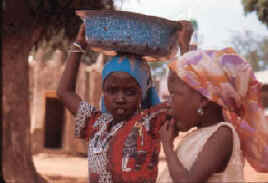
Hausa girls selling food in Zaria, Nigeria |
4. Ecological Concepts in Anthropological Human Ecology: Illustrations from Mormon Settlement in Northeastern Arizona. in Scott Wright, Thomas Deitz, Richard Borden, Gerald Young and Gregory Guagnano, eds., Human Ecology: Crossing Boundaries. Society for Human Ecology: College Park, MD, pp. 255-271. (1993)
5. Ecology and Mormon Settlement in Northeastern Arizona. In D. Bates and S. Lees (eds.), Case Studies in Human Ecology, pp. 365-391. New York: Plenum Press. (1996)
6. Materialist versus Non-Materialist Explanations of Mbuti Pygmy Subsistence Behavior. In Serge Bahuchet, Daniel Bley, Bernard Brun, Nicole Licht & Helene Pagezy (eds.), L'Homme et la Foret Tropicale. Marseilles: University of Provence Press, pp. 301-309. (1999)
Articles in Non-Refereed Journals
1. Introducing Research Reports into Introduction to Physical Anthropology Courses. SACC Notes: Teaching Anthropology. Society for Anthropology in Community Colleges. Fall 1990: 4-8.
2. The Real Chief Seattle was Not a Spiritual Ecologist. The Skeptical Inquirer (March/April) 1999: 44-48.
Book Reviews in Refereed Journals
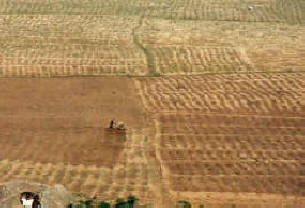
Hausa Farmers, northern Nigeria