ON THE IMPORTANCE OF BEING
SKEPTICAL!
Spring 2006
|
|
|
Class
Time: |
T/Th:
3:00 - 4:15
|
|
|
|
|
Office
Hours: |
T/Th:
2:00 - 3:00
W: 12:00 - 1:00
|
|
 |
1.
William L. Rathje, Cullen Murphy,
Rubbish!: The Archaeology of
Garbage, University of Arizona Press.
2001.
2. Bjorn
Lomborg,
The Skeptical
Environmentalist: Measuring the Real State of the World.
Cambridge University Press. (2001).
3. David
L. Gollaher,
Circumcision: A History of
the World’s Most Controversial Surgery.
Basic Books (2000).
4. Emmanuel
Babatunde,
Women’s Rights versus
Women’s Rites.
Africa World Press, Inc. (1998)
5. Michael
Baigent, Richard Leigh, Henry Lincoln,
Holy Blood, Holy Grail.
Dell; (1983)
6. Paula
Fredriksen, From
Jesus to Christ : The Origins of the New Testament Images of Christ,
Second Edition. Yale University Press
(2000)
7. Elaine Pagels,
The
Gnostic Gospels.
Vintage; (1989)
Course Description:
People in all
societies, including the United States, possess beliefs which they assume are
true and which they seldom question. These beliefs are generally acquired through family,
school, church, government and the media. Such beliefs often gain uncritical
acceptance because their validity is reinforced through all of these
institutions simultaneously. However, many generally accepted beliefs contain
little, if any, validity. Indeed, we need only examine the many beliefs that were
formerly assumed to be true in order to caution us against accepting our current
beliefs too uncritically. General principles of scientific reasoning exist
which can be applied to critically evaluate the validity of commonly held
beliefs. This course will employ these principles to examine several widely
accepted beliefs in our own society in order to determine the extent to which
these beliefs survive the scrutiny of critical evaluation. As an essential part
of the critical evaluation process, the course will also explore the reasons why
erroneous beliefs endure in the face of evidence to the contrary. In
particular, it will examine the way in which the interests of individuals and
groups contribute to the persistence of false beliefs. The purpose of the course
is to demonstrate the value of approaching
all beliefs from a skeptical
perspective.
Teaching Methods:
A variety of teaching techniques will be used throughout the course,
including lectures, class discussions, small-group discussions, films, and
out-of-class assignments. In addition, reading assignments will be given
in the form of handouts distributed in class, Internet sites, email
messages as well as articles audio and video tapes placed on reserve in
the Trexler Library. These different sources of information and methods of
teaching are used to complement and reinforce each other in order to
increase the depth and the scope of the student's understanding of the
material included within the course.
Grading Policy:
1. ALL
assignments must be completed at the scheduled time. Late essays will only be accepted in the event of an
emergency
and will receive a 10-point
reduction in grade for each day they are late,
i.e., a score of 80 will be recorded as a 70, 60, 50,
etc. (Computer problems or printer dysfunction are
NOT valid
excuses for a late paper. They indicate that the student waited
until the very last minute to complete an assignment.) Similarly,
incomplete course grades will be reduced by 10 points when they are
completed. The grade on any assignment not completed
will be zero. Plagiarized assignments will also receive a grade of
zero.
2.
Attendance will not be taken, but absence from class is
NOT
an acceptable excuse for a student's failure to complete an assignment. It is the student's responsibility to obtain the
necessary information on days that he or she misses class. In
addition, a student who regularly misses class cannot expect special
consideration in the event of poor grades.
4. In
the final analysis, responsibility for completing all course requirements
rests with the student. If the student has any doubt on any matter
regarding the course, he or she should contact the instructor
BEFORE
the problem becomes insurmountable. One of the benefits of the small
size of the Muhlenberg Campus is the potential that exist for easy
faculty-student contact.
5,
Twenty
percent (20%) of a student’s grade in the course is based on
participation. Each student in the class begins with a "C" (73) for
participation, and their individual grade increases or decreases depending
upon the quality of their participation. I expect students to attend
ALL
classes. While I don’t grade down for one or two classes
missed, excessive absences result in a reduced grade for participation.
(Obviously, if a student is not in class, participation for that day is
zero.) I assign a higher participation grade for
those students who
contribute positively
to class discussions or who discuss issues with me in my office or through
email. Conversely, I assign a lower grade for those students who
come to class unprepared, who do not participate in class discussions, or
whose classroom behavior is inappropriate or disruptive.
2.
Plagiarism constitutes a
violation of the Academic Behavior Code and will be dealt with
VERY STRICTLY. Faculty in the Sociology
and Anthropology Department treats plagiarism cases very seriously.
Depending on the nature of the plagiarism, a student could receive a
failing grade for the course; be referred to the Dean's Office for
judicial review; and have a "VF" (violation of Academic Behavior Code)
grade entered on their transcripts. If a student is in doubt about a
specific situation, it is his or her responsibility to consult the
instructor or some other appropriate person (such as a librarian or
writing tutor) for clarification.

~ ~ ~ ~ ~ ~ ~ ~ ~ ~ ~
First Year Seminar
Spring 2006

~ ~ ~ ~ ~ ~ ~ ~ ~ ~ ~
|
WEEK OF:
|
TOPIC |
READING ASSIGNMENTS* |
|
1-17
& 1-24 |
Introduction: Learning to Be Skeptical
|
Bigot: One who is obstinately and zealously
attached to an opinion that you do not entertain. --
Ambrose Bierce |
|

Declaration
of War on the New Age.
|
1.
Chief Seattle's 1854
Speech
2. Mander, "What You
Don't Know about Indians."
(R)
3. Hughes,
"The Unspoiled Continent." Chapter
1 in
American Indian Ecology.
(R)
4. Deloria, "Indians
Today, the Real and the Unreal", Chapter 1 in
Custer
Died for Your Sins. (R)
5.
Goodrich,
Attack on the Kiowa.
6. Susan Jeffers,
Brother Eagle, Sister Sky. (R)
* *
* * *
7. Krech,
"Introduction,"
The Ecological Indian.
8. Abruzzi,
The Myth of Chief Seattle.
9. Smith,
For All Those
Who Were Indian in a Former Life.
Film: "Plastic Shamans, White
Medicine
Men"
(R)
|
~ ~ ~ ~ ~ ~ ~ ~ ~ ~ ~
|
1-31 |
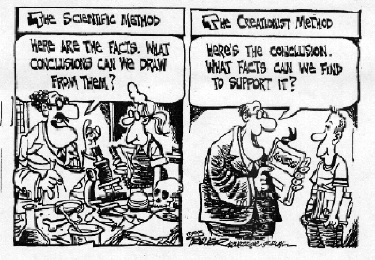
Baloney
Detection
|
THE NEW LOGIC: It
would be nice if it worked.
Ergo,
it will work." --H.L. Menken
|
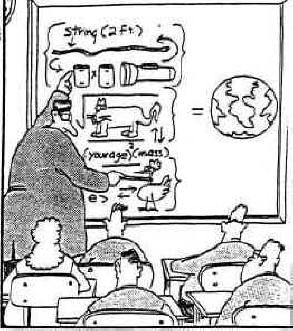
Creationism
Explained
| |
"The aim of scientific research is to
formulate explanatory theories which are: (1) predictive (or
retrodictive), (2) testable (or falsifiable), (3) parsimonious, (4) of
broad scope, and (5) integratable or cumulative within a coherent and
expanding corpus of theories."
--Marvin Harris (1994)
|
|
"Propaganda does not
deceive people; it merely helps them to deceive themselves."
--Eric Hoffer
| |
U.S. Forest Facts
1. About 33% of
the U.S. land area, or 298 million ha (737 million acres), is forest
land.
2. The nation's
forest land area is still about two-thirds the size it was in the year
1600, in spite of the conversion of 370 million acres of forest land to
other uses, principally to agriculture.
3. More trees
are growing in America's forests today than at any time since the early
1900's.
4. In 1900,
forest growth rates were a fraction of harvest. Today, overall annual
forest growth exceeds harvest by 37%.
5. Net annual
forest growth has
increased 62% since 1952, and total growth per acre has increased 71%.
6. Nationally,
standing timber volume per acre in U.S. forests is 30% greater today
than it was in 1952.
7. On a per acre
basis, net annual tree growth in the U.S. is 52 cubic feet compared with
27 in Canada and 24 in Russia.
8. Annual growth
in National Forests now exceeds harvest by more than 55%.
_________________________________________________________________________________________
SOURCE: The
Bugwood Network (The University of Georgia - Warnell School of Forest
Resources and College of Agricultural and Environmental Sciences)
| |
"Some people have this
vision -especially back East- that we're running out of trees.
We're not running out of trees. We're running out of agreement
on what to do with all these trees."
--Jack
Ward Thomas, former chief of the U.S. Forest Service.
|
|
|
|
~ ~ ~ ~ ~ ~ ~ ~ ~ ~ ~
|
2-7 & 2-14 |
That's a
Bunch of Garbage!
|
No
folly is more costly than the folly of intolerant idealism. --
Winston Churchill |
~ ~ ~ ~ ~ ~ ~ ~ ~ ~ ~
|
3-7 thru 3-21 |
Confronting
the
Skeptical Environmentalist
|
Creator: a comedian whose audience is afraid to laugh.
--
H.L. Menken |
|

"Paul
Ehrlich gets Stanford 'Reviewed.'"

* *
* * *
On Ozone Depletion
1.
EPA: The Science of Ozone
Depletion.
2.
NASA:
Stratospheric Ozone Depletion
3. Fahey,
Twenty
Questions and Answers about the Ozone Layer.
4.
Common Ozone Depletion
Myths
5.
Environmental
Effects of Ozone Depletion.
6.
Rensberger, “A Reader’s Guide to
the Ozone Controversy.” The Skeptical Inquirer.
* * *
On Overpopulation
1.
Abruzzi,
On
Overpopulation
2.
Abruzzi,
"Sociopolitical Implications of the Persistent Western Concern with
Global Population
Growth" FORUM.
3. Ehrlich,
The Population Bomb, Chapters 1 & 2.
(R)
4. Weeks,
Population,
"A Demographic Perspective" & Chapter 1.
(R)
5.
Six Billion People
6. Ryerson, 16
Myths about Population.
10. Hartmann,
"Introduction" Reproductive Rights and Wrongs.
(R)
11. Pradervand, "The Neo-Malthusian Myth."
(R)
13. Murdoch,
The Poverty of Nations, Chapter 1.
(R)
14.
Simon,
The Economics of Population Growth, Chapter 1.
(R)
17.
Wilmoth & Ball, The Population Debate in American Popular
Magazines, 1946-90. Population
and Development Review.
[JSTOR]
21. Bongaartz, Population
Growth and Global Warming. Population and Development Review.
(1992)
[JSTOR]
* * *
|
1. Bjorn Lomborg,
The Skeptical
Environmentalist: Measuring the Real State of the World.
2.
Controversy Surrounding the
Skeptical Environmentalist
3.
Crichton, Remarks to
the Commonwealth Club.
* *
* * *
4.
Abruzzi,
On Overpopulation
5.
Weeks,
Population,
"A
Demographic Perspective" & Chapter 1.
(R)
6.
Pimentel, et.al.,
"Impact of Population Growth on Food Supplies and Environment."
* *
* * *
7.
Fahey,
Twenty Questions and Answers about the Ozone Layer.
8.
Rensberger,
“A Reader’s Guide to the Ozone Controversy.”
The Skeptical Inquirer.
9.
A Paleo
Perspective on Abrupt Climate Change
10.
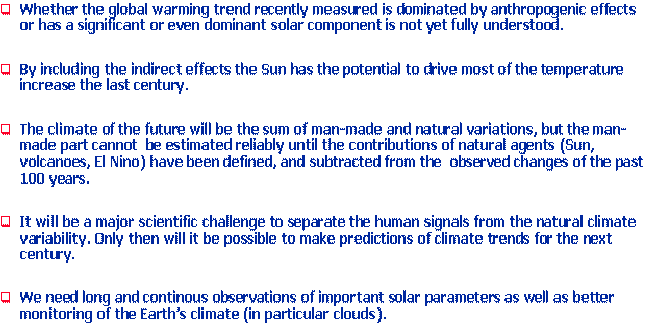
Baliunas, "Why So Hot? Don't Blame Man, Blame the Sun."
Wall Street Journal.
* *
* * *
11.
Wilson, et. al.,
"Biodiversity Distortions in Lomborg's
The
Skeptical Environmentalist"
12.
Mann,
Extinction: Are Ecologists Crying Wolf?
Hurricanes and Global Warming
* *
* * *
On Global Warming
1. "Global
Warming", U.S.
Environmental Protection Agency.
2. "Global
Warming."
National Resource Defense Council.
3.
"A Closer Look at Global Warming."
U.S. National Academies of Science.
4. "Global
Environment." Union of Concerned
Scientists.
5.
"Two Sides, Two Data
Sets",
Science
6. "Global
Warming: Does It Exist? If So, Is It man or Sun-made?"
Solar Center, Stanford University.
7.
Calvin, "The Great Climate Flip-Flop",
The
Atlantic Monthly.
8.
Cromie, "Brightening Sun is Warming Earth.
Harvard University Gazette.
9. Kirby, "Animals
Retreat as Antarctic Cools."
BBC News
10. "A Paleo Perspective
on Global Warming."
National
Oceanographic and Atmospheric Administration (NOAA).
11. "Global Warming,"
Skepticism.Net.
12.
Climate Science.
13.
Earth's
Climatic History
14.
Climate
and the Carboniferous Period
15.
A
Paleo Perspective
on Abrupt Climate Change
16.
Rushing to Judgment
17.
Global Warming: A Chilling Perspective
18.
The Petition Project
19.
Lindzen,
Global Warming: The Origin and Nature of the Alleged Scientific Consensus.
20. Baliunas, "Why So Hot?
Don't Blame Man, Blame the Sun."
Wall Street
Journal.
* * *
On Species Extinction
2.
Wilson, Diversity of Life (1992)
3.
Ehrlich, Extinction
(1981)
4.
Myers
The Sinking
Ark (1979)
6. Stevens, "Species loss: Crisis or False Alarm?"
[R]
7.
Mass
Extinctions: Introduction
8.
Devonian
Mass Extinctions
9.
Mass
Extinctions of the Phanerozoic Menu
10.
Mass Extinctions
Underway
11. Shwartz,
Global extinction crisis more serious than previously thought, study
suggests
* * *
|


Spring
Break: March 4 - 12
|
3-28
|
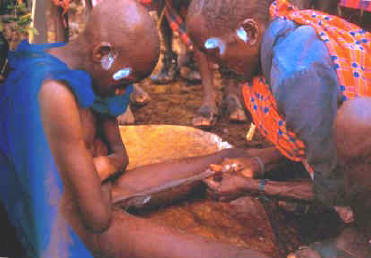
OUCH!: Putting Female Circumcision in Perspective
|
Convictions are more dangerous enemies of truth than lies. --
Friedrich
Nietzsche |
~ ~ ~ ~ ~ ~ ~ ~ ~ ~ ~
|
4-4 |
Genesis and Exodus: Book 1 & 2 of the Bible
|
"Satan
hasn't a single salaried helper; the opposition employ a million."
-Mark Twain |
|
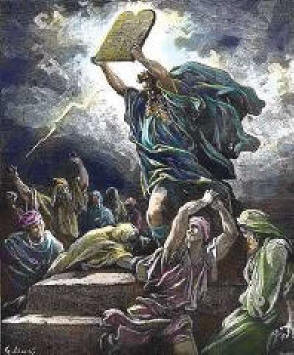
Moses and the Exodus from Egypt
On
the name, "Moses"

Become
an ordained member
of
the Spiritual Humanist clergy |
1. Baigent, Leigh and
Lincoln, “Scholarship and Public Understanding”
(R)
2. Friedman, "Taking
the Biblical Text Apart" Bible Review 21 (2005). (R)
3. Genesis
& Exodus.
Bible Gateway
4. Levine,
Old Testament,
Lectures 1-3 & 8. (R)
5.
Asimov,
Asimov's
Guide to the Bible: Old Testament, vol. 1,
Chapters 1 & 2. (R)
6. Silberman, “Who
Were the Israelites?” (R)
7.
Abruzzi,
Geneology, Politics, History (and
a Little Sex) in the Bible.
8.
Kramer, History Begins at Sumer.
(R)
a.
"Paradise: The First Biblical Parallels." (Ch.
19).
b.
"A Flood: The First Noah." (Ch. 20).
c.
"Tales of Gilgamesh: The First Case of Literary Borrowing."
(Ch. 23).
Bible Gateway
Bible Review

Dear
Dr. Laura
|
|
|
The Religious Divide in America
"America is one of the most
religious countries in the industrialised world. Over 80% of Americans claim
to believe in God, compared with 62% of the French and 52% of Swedes. About
two-thirds of Americans claim membership of a church, 40% go to church once
a week, and 43% describe themselves as born-again Christians. Three times as
many people believe in the Virgin birth as in evolution. . . .
But America is also
one of the most secular countries in the world. The constitution guarantees
a rigorous separation of church and state, and secular groups are assiduous
in using the courts to enforce that separation. (On February 25th, the
Supreme Court ruled that states could withhold scholarships from students
studying divinity.) Public schools recoil from even the mildest religious
imagery. More than 29m Americans say that they have “no religion”, a number
that exceeds all but two religious denominations, Roman Catholics and
Baptists. For the most part, the people who run America's media industries
in New York and Hollywood are aggressively secular, combining intellectual
hostility to Middle America's religious fundamentalists with a generous
measure of cultural disdain."
--The
Economist (February 28-04)
|
|
Easter
Break: April 14 - 17
|
4-11 thru 5-2 |
From Jesus to Christ:
The Transforma-tion
of a Local Galilean Prophet into the Savior of All Mankind
|
"Faith
can move mountains, but not furniture."
--Anonymous
|
|
Saints
and Relics and Other Weird Stuff
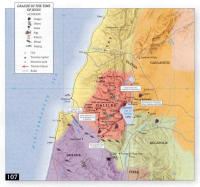
Bible
Maps
What
Would Jesus Eat?

Saint.
Elvis the Divine |
1.
Michael Baigent, Richard Leigh, Henry Lincoln,
Holy Blood, Holy Grail.
Dell; (1983)
2.
Paula Fredriksen, From
Jesus to Christ : The Origins of the New Testament Images of Christ,
Second Edition. Yale University
Press (2000)
3.
Elaine Pagels,
The Gnostic
Gospels.
Vintage; (1989)
4 . Abruzzi,
The
Jesus Movement.
5. Ehrman,
The Historical Jesus,
Lectures 1-4. (R)
6. Ehrman,
The New Testament,
Lectures 5-8, 13 & 18. (R)
7. Schaberg, "How Mary
Magdalene Became a Whore." (Bible Review, October, 1992).
[R]
8.
The Gospel of Thomas
9.
The Gospel of Mary Magdalene
10.
The Gospel of
Phillip
The Nag Hammadi Library

Early
Christian Writings
FILM:
Jesus, Mary and Da Vinci
(R)
MAP: Palestine under the Maccabees
MAP: Palestine in the 1st Century
MAP: Expansion of Christianity
Mother
Theresa's Exorcism
|

Is
Barney the ANTICHRIST?
* *
* * *
Controversies in
Christianity
How do we evaluate them?
|

|
 |
|
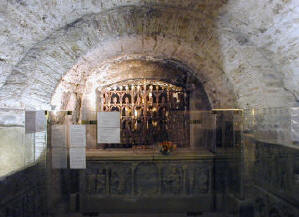
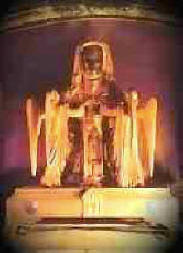
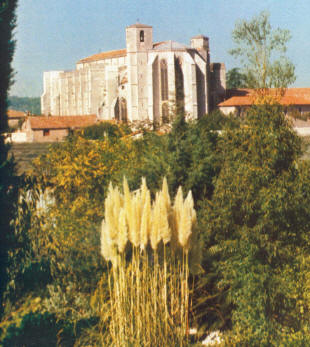
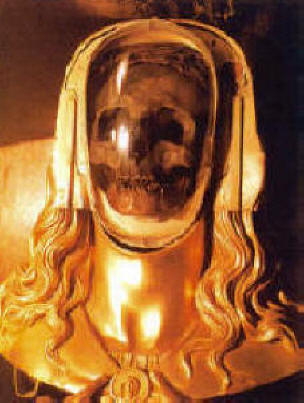
The Mary Magdalene Reliquary
(above left) is located in a crypt located beneath the Basilica to Mary Magdalene in
Saint Maximin de Provence, France (above center) where Mary Magdalene is
purportedly buried. The reliquary contains what many believe is
Mary Magdalene's skull (see above right). According to local beliefs,
Mary Magdalene left Palestine with Mary (the mother of Jesus) and Mary (the
aunt of Jesus) and landed at what is today known as Sts. Marie de la Mer, a small village on the Mediterranean
south of St. Maximin. According to local tradition, Jesus' mother and aunt
remained in Sts. Marie de la Mer, while Mary Magdalene left the village to live
naked (with just her long hair covering her body) as a hermit for 33 years in a cave at Baume (southeast of St. Maximin).
Each year in late May, Gypsies converge on Sts. Marie de la Mer to celebrate the
landing of the three Maries in southern France.
|
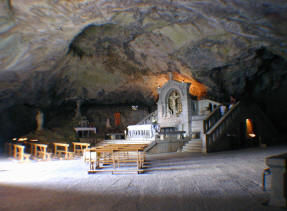
Chapel in the Cave at St.
Baume where Mary Magdalene is believed to have lived for 33 years as a
hermit following the death of Jesus.
|
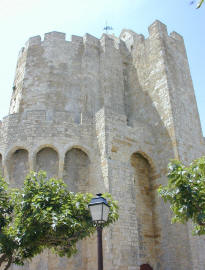
St. Maries de la Mer
Church where the remains of the two Mary's are believed to reside.
|
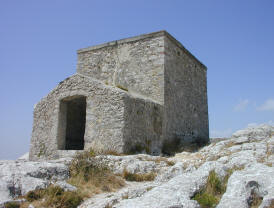
Chapel on the cliff above
the Cave at St. Baume where Mary Magdalene is believed to have been carried
to heaven by angels. |
|
Last Day of Class: Thursday, May 4th

Home Page